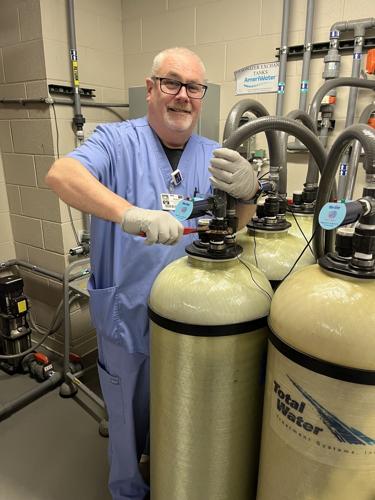
Mike Prescott
“It was an experience that dramatically improved my life,” said Mike Prescott of Kenosha, who retired a couple of years ago after a career in the auto industry and now works in the Kidney Center at Froedtert Pleasant Prairie Hospital.
Since 2020, Prescott has experienced atrial fibrillation — commonly known as a-fib — a condition that causes irregular heartbeats that may result in symptoms such as dizziness, shortness of breath, chest pain, fatigue, a racing heartbeat and anxiety. “My heart rate would go from 60 beats a minute to 200 or more, even when I was sitting in a chair,” he said. “And this was happening every hour or two.”
Medications and electric shocks to restore his normal heart rhythm helped for a while but didn’t eliminate his a-fib, so he underwent an ablation procedure. Soon after, he began passing out without warning and had to have a pacemaker implanted. “I felt healthier at that point, but the underlying issue wasn’t solved,” he said. “Then I found out there was someone at Froedtert South who could help me.”
An a-fib specialist
Dr. Indrajit Choudhuri is an Electrophysiologist at Froedtert South who specializes in helping patients with heart rhythm problems. “Mike stopped me in a hallway one day and asked me about his condition,” Dr. Choudhuri said. “I assured Mike that the severe symptoms his a-fib was causing were not permanent and told him I was confident that we could help him.

Dr. Indrajit Choudhuri, Electrophysiologist at Froedtert South
“Every a-fib patient is different, so everything we do is tailored to the patient’s goals and their medical needs,” Dr. Choudhuri added. “In Mike’s case, we determined that he may respond well to hybrid ablation, due to the resistant nature of his a-fib.
“Traditional ablation addresses the electrical signals and muscle cells on the inside of the heart,” Dr. Choudhuri said. “In people with longstanding a-fib that is resistant to medications or traditional ablation, this is often due to involvement of the full thickness of the atrial heart muscle, so the hybrid ablation approach involves ablation on the outside of the heart coupled with ablation on the inside of the heart, performed in a two-part procedure.
“In the first procedure a surgeon performs a minimally invasive ablation to the outside of the heart,” Dr. Choudhuri continued. “This addresses the outside muscle wall and also targets regions where nerves on the outside of the heart can contribute to the irregular heartbeats that trigger a-fib. The second procedure is a more traditional approach to target areas on the inside of the heart.
“The surgeon who completed this first stage made a small incision just below Mike’s breastbone and inserted catheters and cameras to reach his heart and ablate an area that is known to maintain a-fib and to block the areas where the abnormal nerve signals insert into the outside, without having to perform full open-heart surgery,” Dr. Choudhuri added. “After a few months, Mike came back to me, and we completed the procedure using a catheter inserted in his groin to block the signals on the inside.”
Looking forward to the future
“Now, I’ve got more energy,” Prescott said. “My co-workers and family say I look a lot better. I’m sleeping better, and I want to go out and do things. In the past, I just wanted to be at home in case something happened. I’ve made a complete turnaround, and I’m looking forward to the future again.
“Dr. Choudhuri changed my life,” Prescott added, “and I am so grateful that I talked to him when I did, or I would most likely be in the same situation I was in before. I encourage everyone with my condition to ask questions.”
“My message to anyone with a-fib is, number one: make sure you’re getting a comprehensive, thorough evaluation by your physician,” Dr. Choudhuri said. “Ask if there’s more that can be done, and ask to see a specialist like me. And two: be aware that there are advanced minimally invasive procedures to better manage a-fib that should be considered, including hybrid ablation.”
“I felt that Dr. Choudhuri truly cared about me and my family and what we were going through,” Prescott said. “He was committed to finding a way to resolve my situation and make my life better.”
“My focus, and the focus of everyone here at Froedtert South, is always on keeping our patients’ best interests as our number one priority,” Dr. Choudhuri said. “People love the services we provide because we always put patients first. Always.”
All about a-fib
- 1 in 4 people can expect to experience a-fib at some point in their life.
- By the age of 80, 15% of people — or 1 in 6 — will experience a-fib.
- Once someone has developed a-fib, they’re likely to have it for the rest of their life.
- To help prevent or delay a-fib, consider:
- Weight loss and healthy weight management
- Healthy diet
- Blood sugar and diabetes control
- Blood pressure control
Patients with a-fib are not without hope. Leading-edge hybrid procedures can successfully manage severe a-fib. A thorough examination by a heart rhythm specialist is a good first step.
For more information, visit froedtertsouth.com.