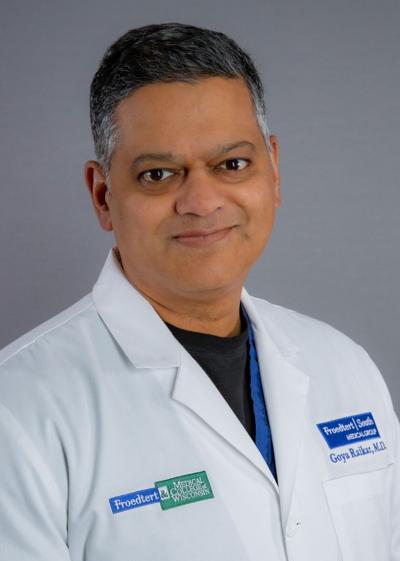


Goya V. Raikar, M.D., FACS, FCCP
The patient was a woman in her 40s who had enrolled in nursing school after raising her two children. Her physician had recently discovered a pea-sized nodule in one of her lungs. This patient had no known risk factors for lung cancer — she neither smoked nor consumed alcohol and had no history of asbestos exposure — so I expected the nodule to be benign.
Her case had been presented to our tumor board, and we were debating whether to attempt a needle biopsy of the nodule — which might be difficult given its small size and location — or to perform another scan in a few months to see if the nodule was growing.
We ultimately decided to use a relatively new, minimally invasive technology called the Ion Robot, which allows us to biopsy hard-to-reach lung nodules more easily. To our surprise, the tumor was malignant, so we immediately removed it. The patient made a fast and full recovery. She recently wrote to me to share that she is finishing nursing school.
Dramatic advances in care
This is precisely the type of work I came to Froedtert Pleasant Prairie Hospital to perform in 2018: minimally invasive, robotic-assisted surgeries for heart and lung cancer patients. About a year and a half ago, I seized the opportunity to collaborate with a former colleague at the West Virginia University Heart and Vascular Institute to advance cardiovascular care. Now, I’m very happy to be back, working with patients in our Kenosha County communities.
When I see a patient with a lung nodule, their first concern is whether it’s cancerous, followed by how it can be removed completely, safely and quickly.
Here at Froedtert Pleasant Prairie Hospital, we have all the technology and, more importantly, all the people — nurse practitioners, nurses, radiation technologists, radiologists, pulmonologists and surgeons — to serve these patients in ways that were not possible just a few years ago.
We are focused on reducing the time between when a patient learns they have a lung nodule and when they begin treatment if necessary. Significant advances in imaging technology have enabled earlier detection of even small nodules. Early detection allows for earlier treatment and improves the chances of removing the cancer before it spreads. A pea-sized lung tumor has likely been growing for two to five years. Once that tumor roughly doubles in size, the risk of it spreading increases dramatically. It is like a ticking time bomb that we want to defuse as quickly as possible.
Before we proceed, we make every effort to answer all of the patient’s questions to ensure they fully understand what will happen before, during and after their surgery. We want every patient to feel confident that we will take care of their cancer so they can focus on recovery and healing.
Tiny incisions equal faster recovery
Thanks to new technologies and procedures, we no longer need to make large surgical incisions in a patient’s chest to remove nodules. Instead, we can perform the entire procedure robotically through much smaller cuts.
The surgery is performed under general anesthesia. We make small incisions and insert tools to collect samples from the lymph nodes and remove the nodule. A specialist is present in the room with us to immediately biopsy the tissue, allowing us to completely remove it if it is cancerous.
The surgical robot we use helps us locate the exact position of a nodule in a patient’s lung. It also magnifies my vision by 10 to 20 times, allowing me to see the nodule and the surrounding tissue much more clearly.
New studies show that this surgery is more effective at removing cancer than the techniques we used in the past and other hospital systems are using today, and the recovery time is much faster — two or three days in the hospital now versus a week to 10 days previously. Most patients return to normal activities within two to three weeks, and the cancer is eliminated. Because it is effective and much better for patients, this approach has become the standard of care for removing lung nodules.
Commitment to local communities
I’m proud that we have committed to acquiring the technology, personnel and expertise necessary to provide this level of care to our communities. Having this cutting-edge technology and expertise right here in Pleasant Prairie means patients no longer need to travel to Chicago, Milwaukee or elsewhere to receive such high-quality care.
I practice medicine because I enjoy going to work and, throughout my day, having the opportunity to help someone in our community gain more quality time with their loved ones. The same is true for every member of my team. It is a privilege we never take for granted.
About the author
Goya V. Raikar, M.D., FACS, FCCP, has built a nationally respected career rooted in innovation, surgical excellence and leadership in cardiothoracic care. He made history by performing the first robotic-assisted mitral valve repair in the Minneapolis–St. Paul region and now serves as Chief Cardiac Surgeon at Froedtert South, where he leads the development of a Robotic Mitral Valve Repair Program at Community Memorial Hospital.
For more information, visit froedtertsouth.com.