
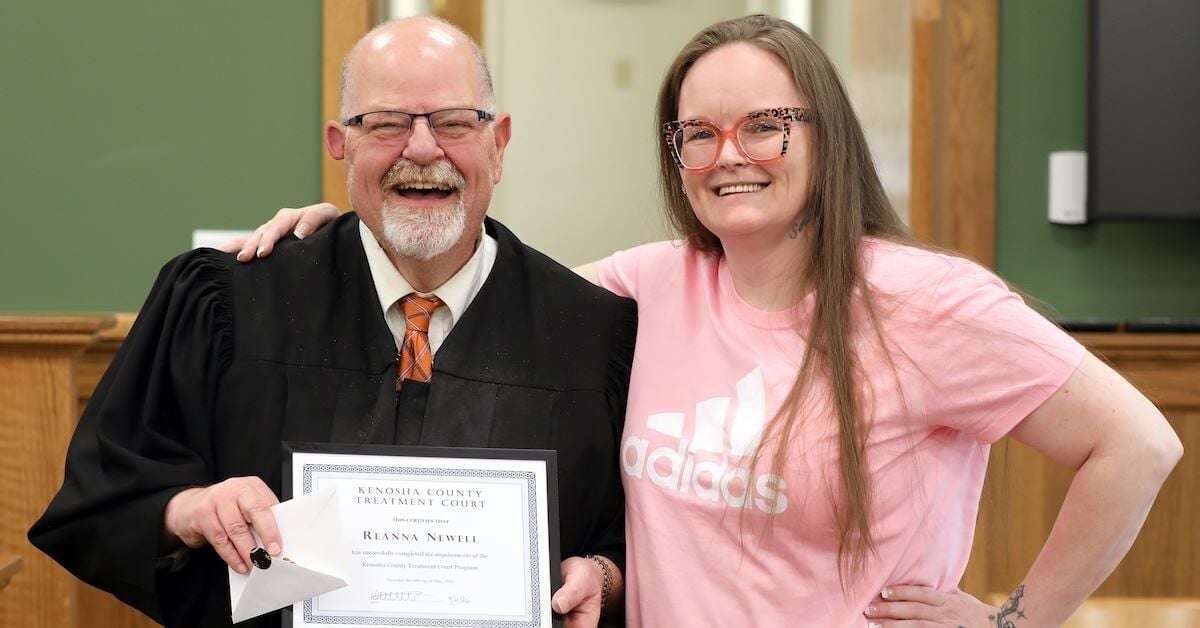
Reanna Newell is the newest graduate of the Kenosha County Treatment Court, but she is already planning a positive return to the program.
Newell, who celebrated her graduation from the criminal diversion court last week, will be back soon as a facilitator for its alumni group, serving as a positive role model for her peers continuing their recovery journeys.
"I just feel like I became a better person from the opportunity that I had to do Treatment Court," Newell told a courtroom full of friends and peers at her commencement celebration.
Newell is the latest of a string of success stories that the court has spawned, providing an opportunity for people struggling with substance use to get their lives on track while avoiding additional time served in jail.
The latter depends on participants following a stringent set of court requirements. In Newell’s case, that included 57 consecutive weeks of negative drug tests, amid close monitoring by Judge David Wilk and the Treatment Court team.
People are also reading…
Prior to Newell, another recent graduate was Devon Roberts, who spent 82 weeks in the program, producing 208 negative drug tests.
All the while, Roberts maintained employment, obtained an apartment and achieved a sobriety that enabled her to be of support to her family — something she could not provide during active addiction or periods of incarceration.
"This program offers an alternative to participants, an opportunity to turn their lives around and build relationships and skills that will allow them to succeed in life," said Treatment Court Coordinator Keri Pint.
The Kenosha County Treatment Court is available to adult defendants who have pleaded guilty to one or more crimes related to their substance use disorder.
Treatment intervention is administered by the judge and a team of Treatment Court professionals, with the court seeking to provide programming and supervision that helps participants to support and maintain a stable life free from alcohol and illegal drugs.
Newell had already logged several years clean from substance use before she entered the program. However, a criminal charge filed in 2024, long after offenses she committed while she was using, threatened to upend her life and send her back behind bars. By enrolling in Treatment Court, she stayed out of jail and continued putting her life back together.
"My son is 16, and for most of his childhood, I was in jail," Newell said.
Similarly, Roberts spent her time in the court holding down a job, reconnecting with her adult son and giving back to the recovery community, facilitating meetings at the Bridges Community Center.
At her commencement ceremony, Roberts thanked the court team, her family and her friends for their support.
"There were many times I didn’t think I was going to make it," Roberts said. "But I did — with the help of my friends."